Materials & Interfaces
Tasks 2-3: non-PGM catalyst development, materials characterisation and MEA engineering.
A coordinated research effort to develop, integrate and validate advanced materials and components for next-generation AEM water electrolysis, progressing from catalyst design to single-cell testing, alternative feed-water studies and stack validation.
Explore five interconnected research activities, spanning the full development pathway from catalyst design to stack validation. Task 1 supports all research activities through project management, communication, and dissemination.
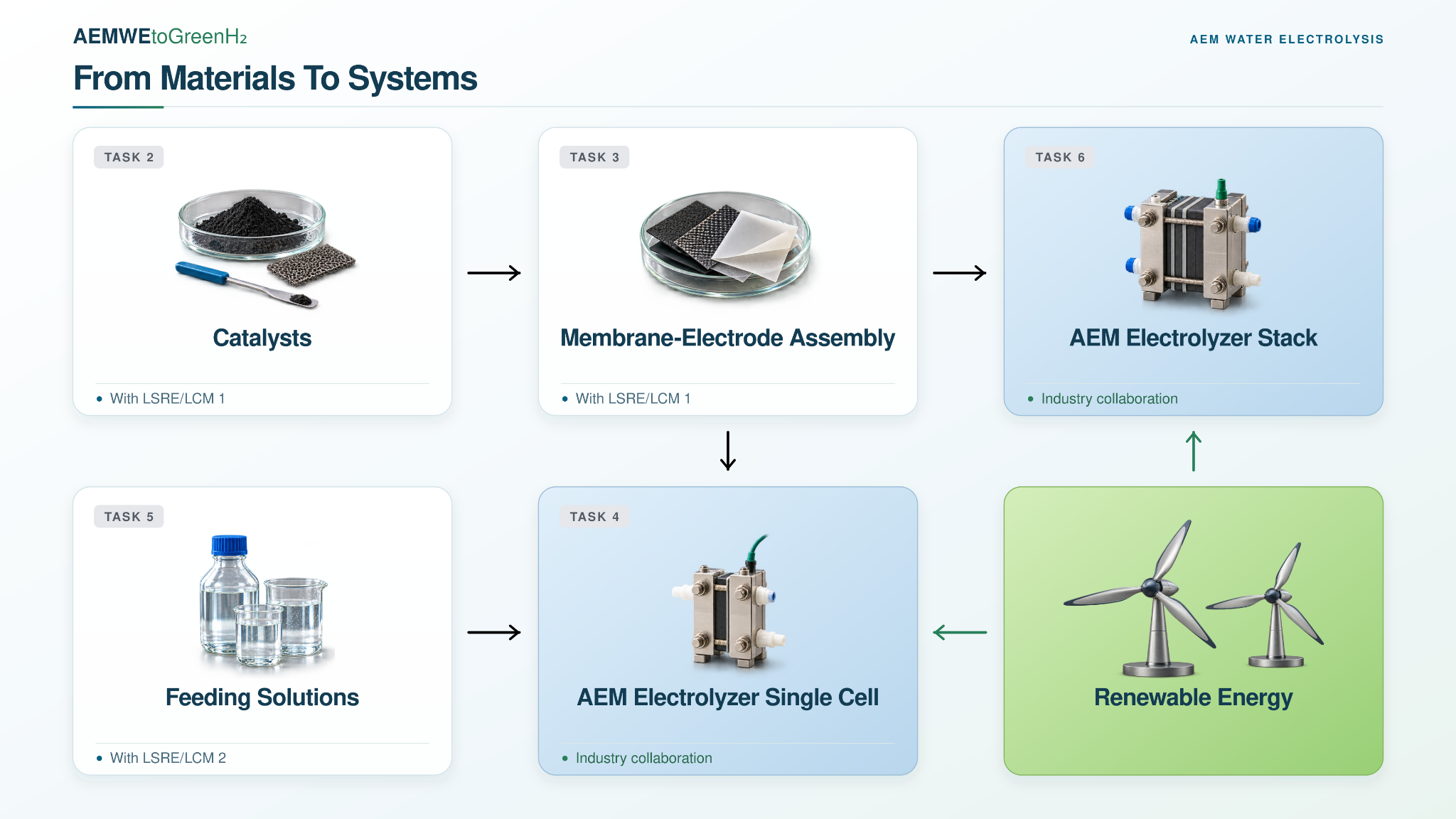
Prepare and characterise low-cost, non-noble electrocatalysts for the hydrogen and oxygen evolution reactions. The most promising materials will be selected using electrochemical and physicochemical characterisation and then integrated into membrane-electrode assemblies.
Optimise the integration of commercial AEMs, ionomers, catalysts and porous transport layers. Catalyst-coated porous transport layers and catalyst-coated membrane approaches will be assessed to improve ionic transport, interfacial contact and long-term performance.
Develop an in-house AEM electrolyzer single cell and evaluate performance under different temperatures, feed solutions, flow rates and pressures. Polarisation curves and electrochemical techniques will be used to identify losses and optimise operating conditions.
Assess component ageing and system stability using durability protocols and accelerated stress tests. Changes in electrochemical performance before and after testing will help identify degradation mechanisms and guide improvements in materials and interfaces.
Explore publicationsInvestigate how feed-water composition affects AEM electrolyzer performance and durability. The project considers alkaline solutions and pure water and explores the use of treated wastewater, identifying critical impurities and possible mitigation or additional treatment strategies.
Scale the most promising materials and MEAs to a 3-5 cell AEM electrolyzer stack with a larger active area and operation at elevated hydrogen pressure. Stack performance, durability and hydrogen production costs will be assessed to support technology scale-up.
The official project is organised in Tasks. The following themes bring together its scientific activities.
Tasks 2-3: non-PGM catalyst development, materials characterisation and MEA engineering.
Tasks 4-5: single-cell design, performance and durability testing, together with the study of alkaline, pure and treated wastewaters.
Task 6: short-stack development, validation at relevant operating conditions and economic assessment of AEM hydrogen production.
Support lower-cost materials and explore reduced dependence on high-quality freshwater through alternative feed-water strategies.
Our objectives
This work is co-financed by COMPETE 2030, by Portugal 2030, and by the European Union, within the framework of the project AEMWEtoGreenH₂- Reshaping Green Hydrogen Production: Development of Anion Exchange Membrane Water Electrolysis, with number 16606 and operation code at the Funds Platform COMPETE2030-FEDER-00778300.